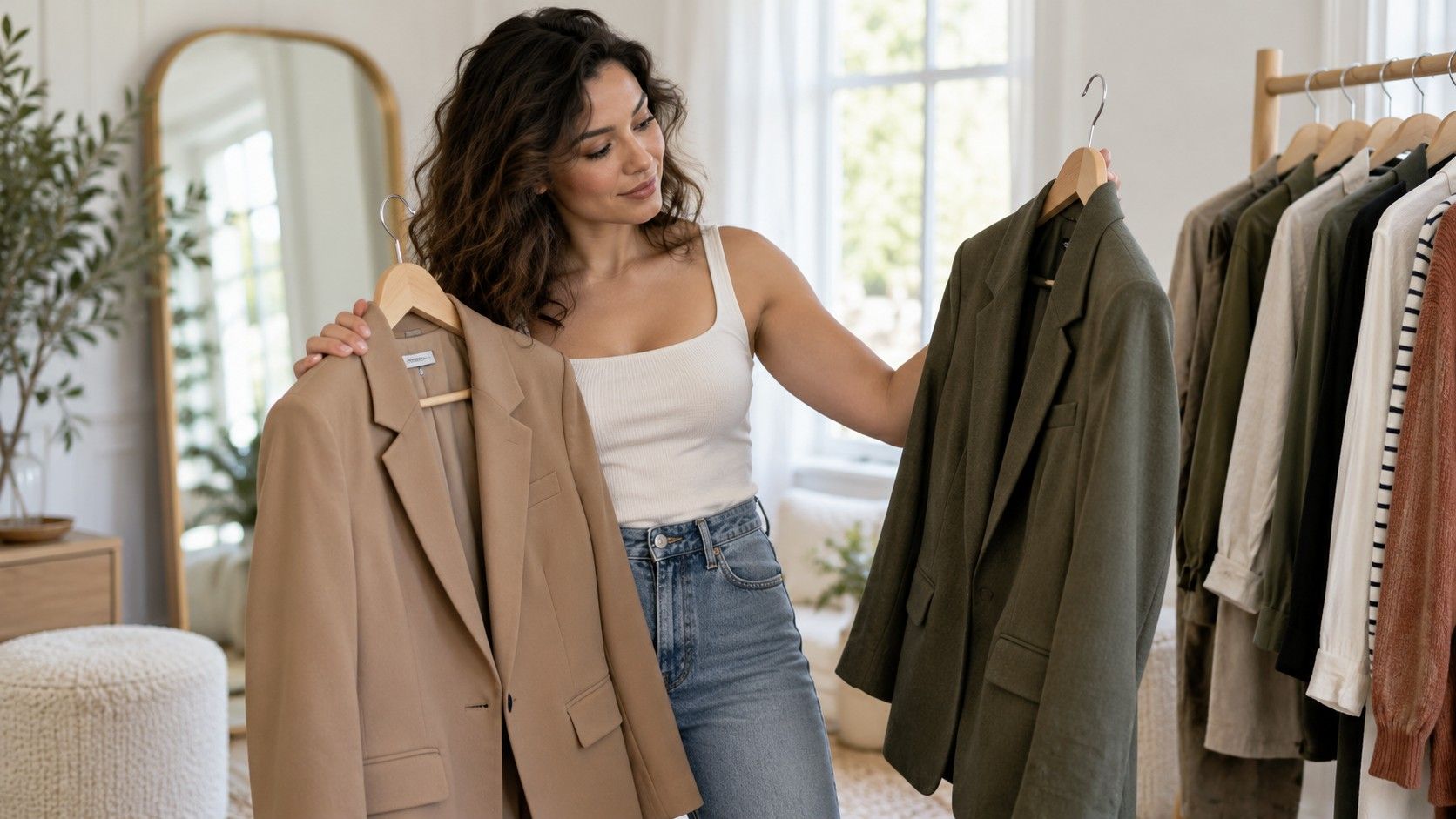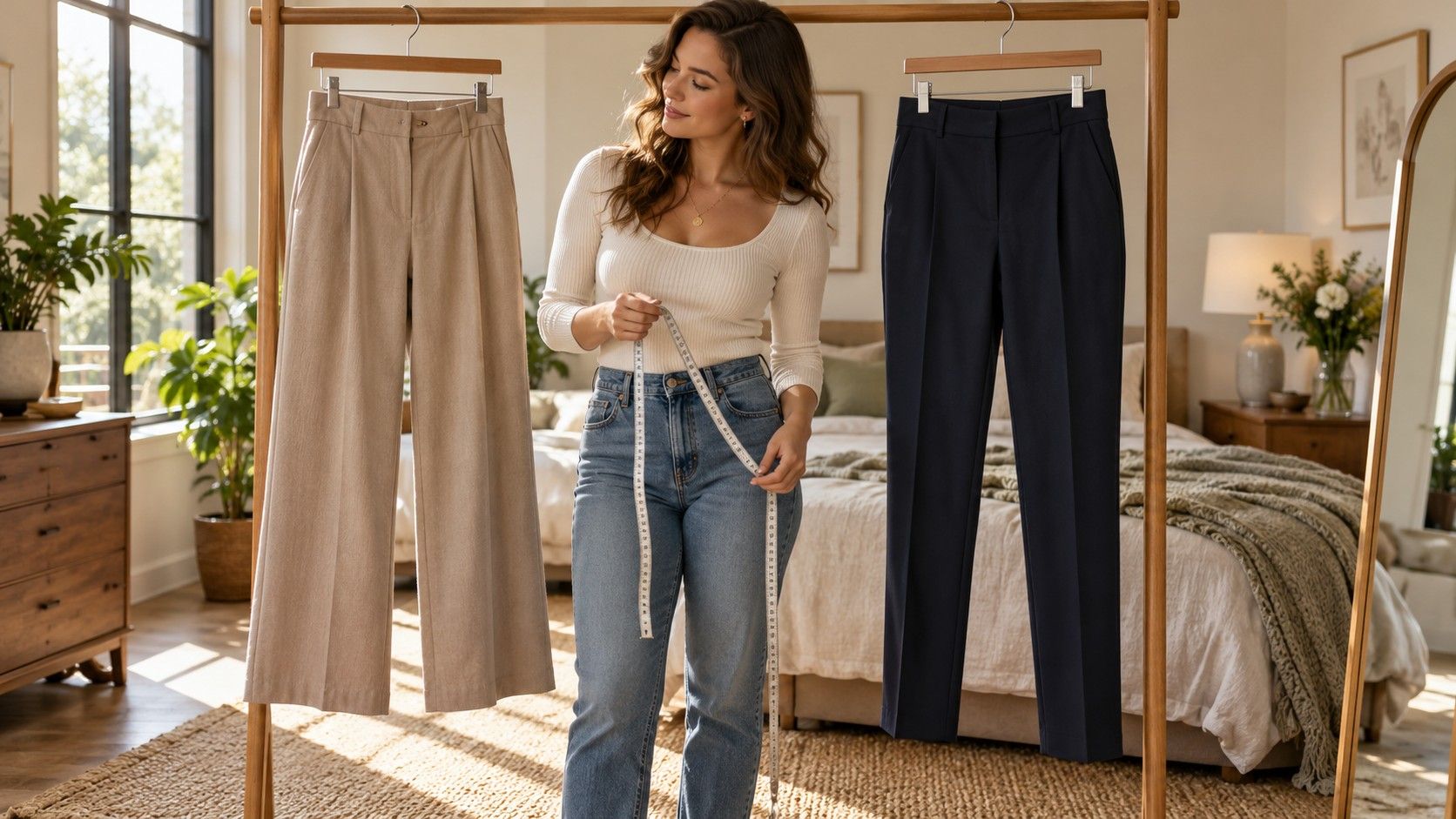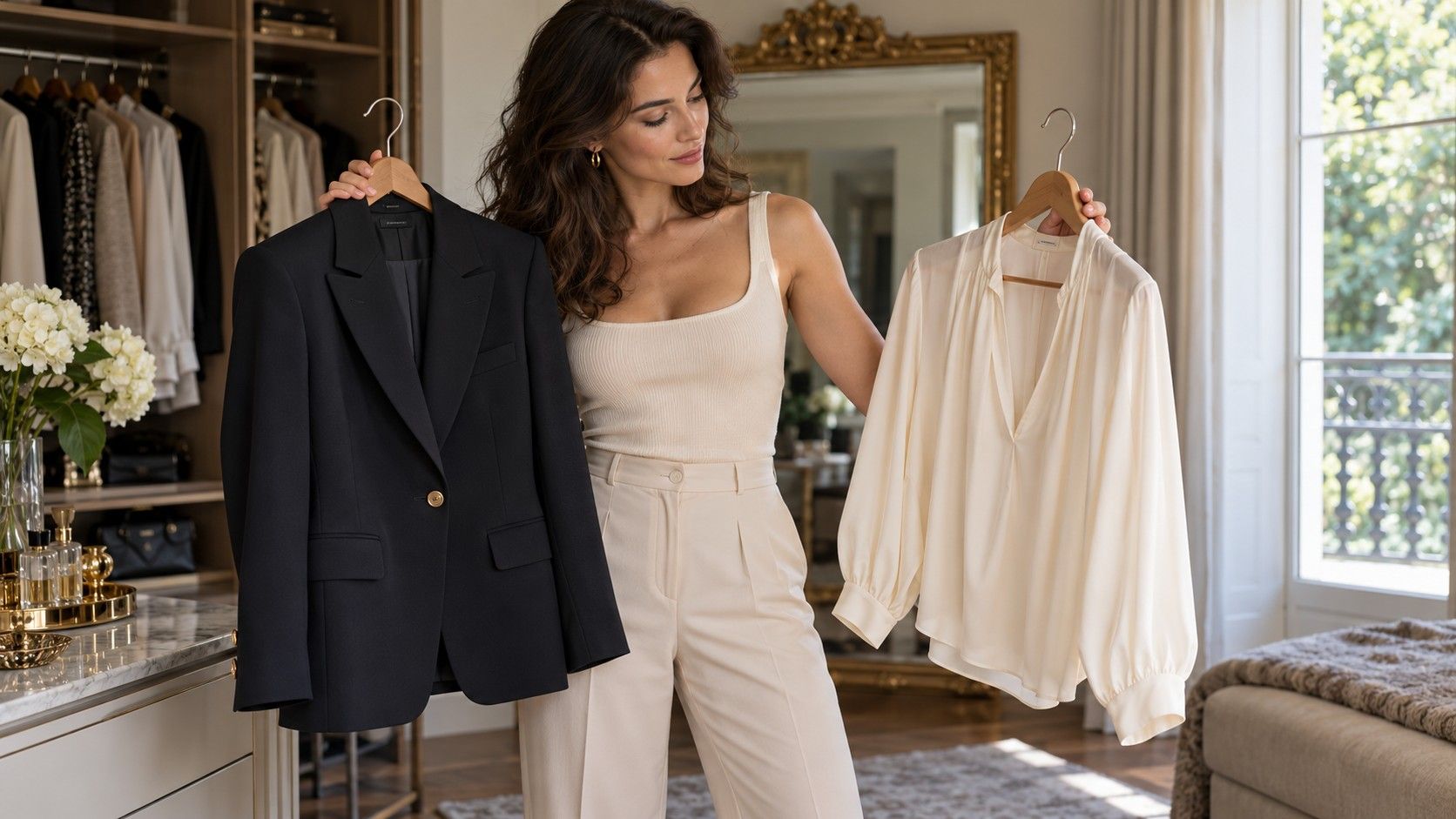
A jacket can fit across the shoulders and still feel wrong with the rest of an outfit. A dress can match a body-shape guide and remain uncomfortable when you sit down. Those are different problems, which is why comparing body shape vs Kibbe helps most when you begin with a particular garment. One vocabulary describes broad proportions; the other offers an approach to a whole image. Neither removes the need to try clothes, check movement and decide what you actually like.
Start with the clothing problem in front of you
Put on an outfit you nearly like and name the difficulty without using a type. Perhaps the blouse pulls between its buttons, the trousers twist at the thighs or the jacket looks more formal than you intended. A pulling button is a fit issue. The relationship between the jacket and the trousers is an outfit question. Your dislike of the formality is a preference. A single label cannot reliably solve all three.
Deal with physical fit first. Check the shoulder seam, room through the upper arm, the waist when seated and the amount of fabric available over the hips. Garment ease means the space beyond the body's measurements; different fabrics and cuts need different amounts. A close-fitting stretch top and a woven shirt can both fit well while having very different outlines. Changing your style category will not add missing room to a tight sleeve.
Next decide what you want the outfit to do. You might want a relaxed line for a casual dinner, a defined waist with a full skirt or a long uninterrupted shape under a coat. These are choices rather than corrections to your body. If you can describe the desired result, a style system becomes a source of suggestions to test instead of a verdict you have to obey.
Use a body-shape label as a rough description
Common body-shape guides use names such as rectangle, triangle, inverted triangle, oval and hourglass. Definitions differ between guides. Some compare bust, waist and hip circumferences; others look at the visible relationship between shoulders and hips. Shoulder breadth and bust circumference are different observations, so two guides can produce different labels without either measuring tool being broken.
A person whose hips measure more than their bust may find a triangle description familiar, but that comparison leaves out torso length, bust projection, posture, upper-arm room and the position of the waist. Two people with similar circumferences can need different trouser rises. One may prefer a shaped waistband; another may need more room through the seat. A shape name is a shorthand, not a sewing pattern.
Use the label to ask better fitting-room questions. Does this straight skirt have enough walking room? Does the shirt hang freely or catch at the hips? Does a belt stay in a comfortable position? Those checks produce information you can use on the next shopping trip. Advice to always broaden, minimise or balance something is optional: it describes a visual preference, not a requirement for getting dressed.
Understand why Kibbe is a different kind of framework
David Kibbe's image approach is associated with image identities and a yin–yang vocabulary for interpreting an overall appearance. It is not a direct translation of triangle, rectangle or hourglass categories. Its named identities belong to an authored styling framework, so a casual online diagram should not be treated as a complete account of that author's work.
In practical outfit discussions, people often use Kibbe-related language to consider how line, fabric, scale and the complete ensemble work together. A broad shape guide may suggest highlighting a waist. An image-based experiment might ask whether the jacket, hem length, jewellery and hairstyle make sense together. That shift from one body area to a whole look is useful even if you never settle on an identity.
Keep the distinction between learning a framework and borrowing an outfit idea. If a softly draped blouse appeals to you, try it with trousers you already wear. You do not have to establish an official identity before deciding whether that combination works for your life. Equally, finding one attractive outfit does not prove a type. Fabric weight, garment construction and your own taste can explain the result without a category doing all the work.
Choose the right tool for the question
The following comparisons help separate a useful observation from a task that needs something more specific. None makes a body classification compulsory.
| Your question | Useful starting point | What to check next |
|---|---|---|
| Why do trousers gap at the waist? | Waistband and seat fit | Try another cut, rise or alteration |
| Do I enjoy a defined waist? | Compare two silhouettes | Comfort and the full outfit |
| Why do these pieces feel unrelated? | Line, fabric and detail scale | Change one element at a time |
| Which image identity am I? | The original framework | Its definitions and the limits of self-assessment |
| Should I buy this jacket? | Movement, weather and existing clothes | At least two usable combinations |
Notice that a purchase decision includes more than appearance. A coat that looks harmonious in a still photograph may be too restrictive for driving or too delicate for your commute. An outfit that meets a guide's proportions may take more ironing than you want. Keep care, mobility and daily use in the same decision as style; they are not secondary details.
Do not ask a calculator or photograph to settle identity
A body-shape calculator performs a comparison based on the numbers and thresholds it is given. It can reproduce that comparison consistently while still leaving out the details that matter in clothes. Moving the tape slightly, measuring over a different bra or using shoulder circumference instead of shoulder breadth can change the input. The output should remain a rough description, particularly near a category boundary.
A photograph has a different set of limits. Camera distance, lens choice, pose, clothing and lighting all affect visible proportions. A mirror selfie taken with the camera tilted down can make one part of the body appear larger relative to another. A stiff jacket may conceal the way a softer fabric hangs. A confident label from an image does not resolve those missing observations.
If you use photos, use them to compare outfits rather than to prove a body identity. Keep the camera near the same height and distance, wear the same shoes and avoid changing pose between options. Look at the images alongside your experience of wearing the clothes. A photograph cannot tell you whether a waistband presses into your abdomen after lunch or whether a neckline needs constant adjustment.
Combine the observations without collecting restrictions
Try a small experiment with a familiar pair of trousers and two tops. Choose tops that differ in one useful way, such as a firm cotton shirt and a fluid woven blouse. Keep the shoes and accessories the same. Compare how each fabric hangs, where the hem lands and whether you can reach forward comfortably. Record a plain observation: “The softer top tucks without bunching” is more useful than “This proves my type.”
Repeat with an open jacket, then with the jacket fastened. You may prefer a clear waist in one outfit and a straighter line in another. That is not an inconsistency to repair. Garments interact with each other, and personal style can accommodate several silhouettes. A fitted top with wide trousers creates a different relationship from a loose top with the same trousers; the individual pieces need not belong to one rigid category.
Keep a short record of successful combinations, including the specific fit features. Note a comfortable rise, enough upper-arm ease, a hem that sits where you like and fabrics that survive your normal laundry routine. If a body-shape description or image framework helps you find more of those combinations, keep using it. If it makes you reject clothes you enjoy before trying them, return to the garment and the evidence you can feel and see.