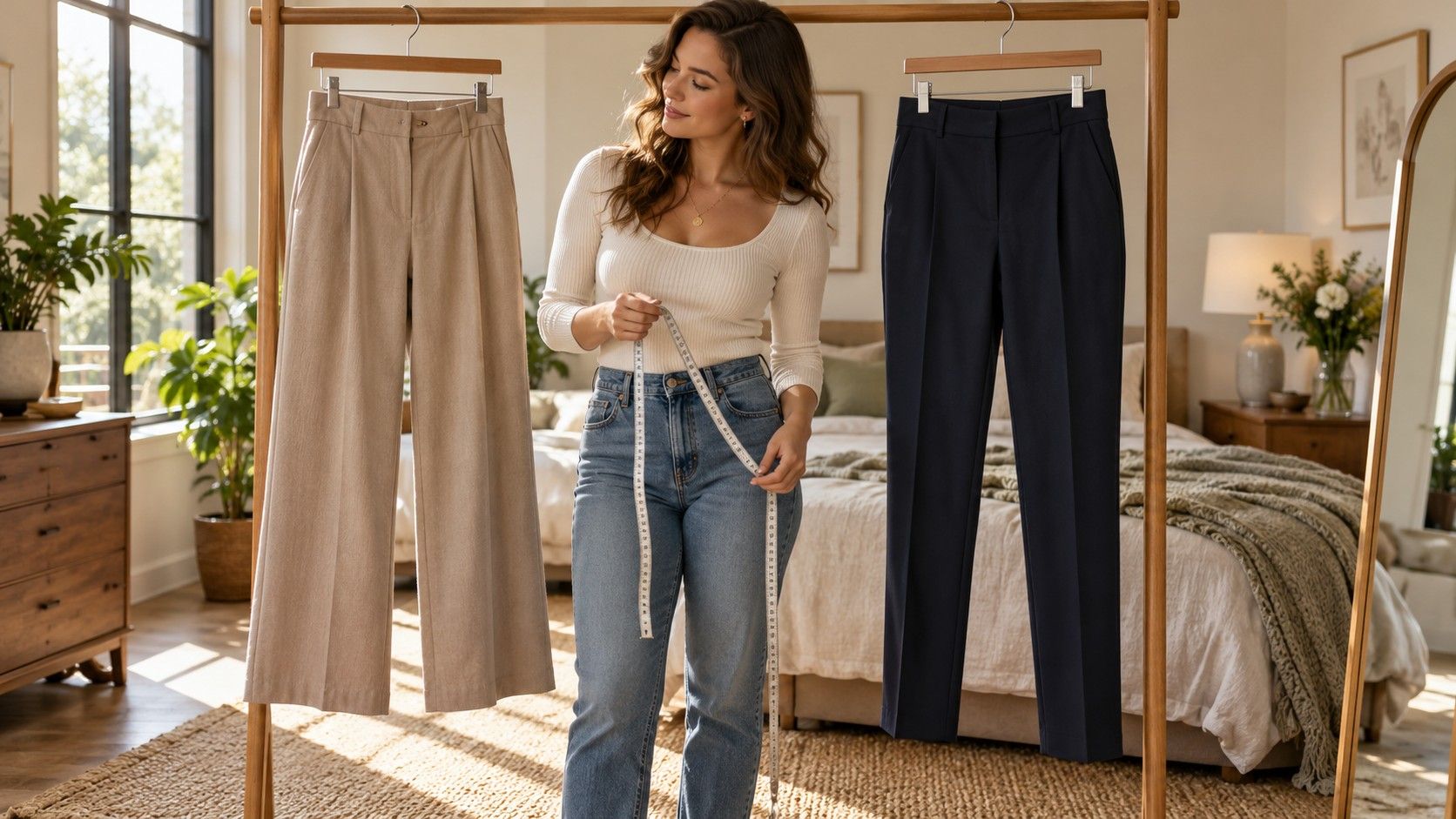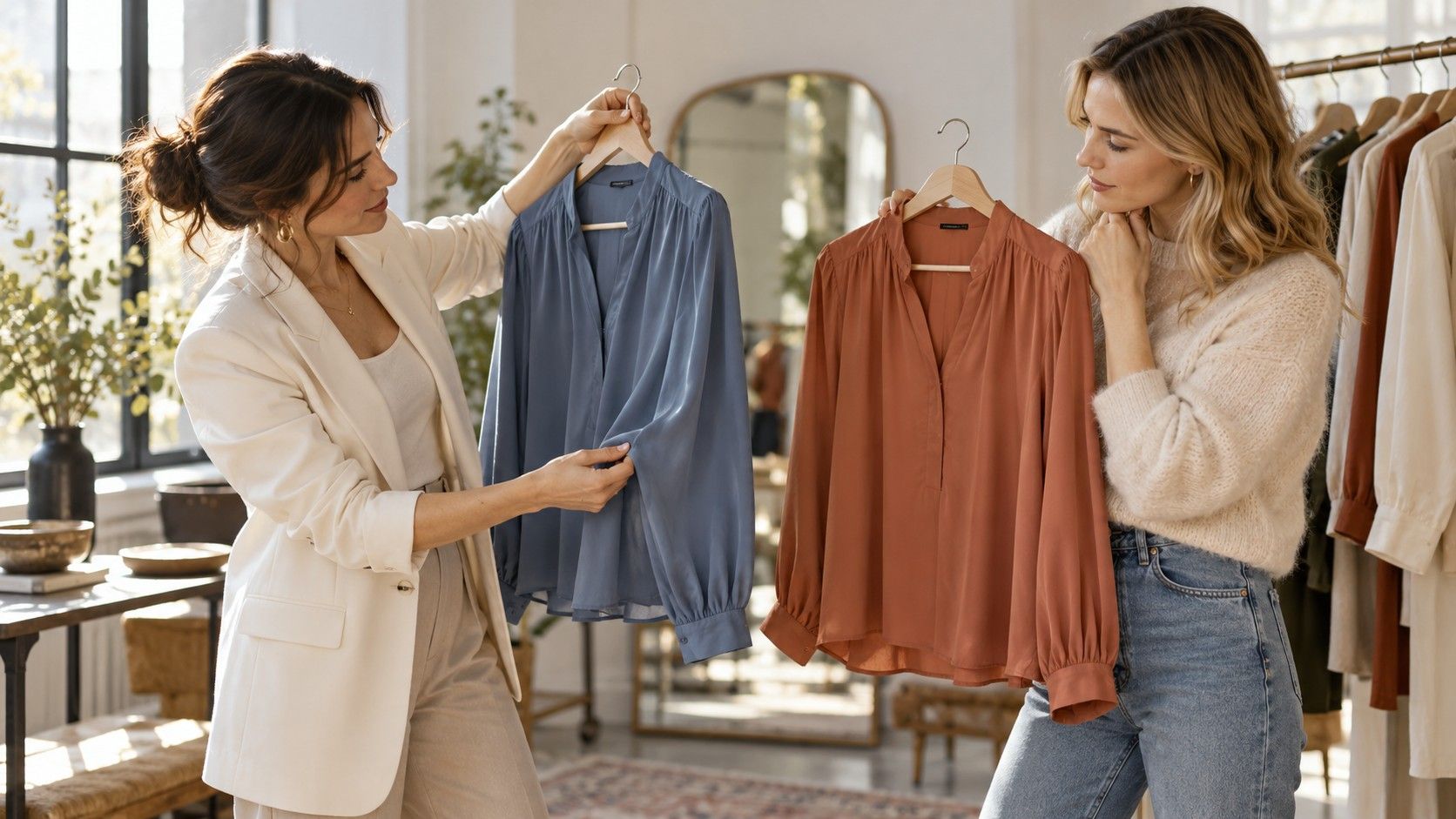
A blouse may fit beautifully and still feel unlike you. Another may have the right mood but pull whenever you reach for a bag. The first problem concerns expression; the second needs a fit solution. When comparing style essence vs body type, separate those questions before adding more labels. You can explore a romantic, crisp, relaxed or dramatic look without asking a body category to choose your personality.
Decide whether you need help with fit or expression
Start with the garment that prompted the question. If the shoulder seam sits awkwardly, the waistband digs in or the skirt rides up, write down what happens and when. “The sleeve pulls while driving” gives you something to check in another cut. “This looks wrong for my essence” may conceal a construction issue that a larger size, a different armhole or more room through the back could solve.
If the garment is comfortable but feels too severe, too delicate or too casual for the occasion, you are considering expression. Try describing the effect without typing yourself: narrow lapels, polished buttons and a smooth finish may feel precise; washed linen and patch pockets may feel informal. You can like either mood, both or neither. Your preference is useful information even when it does not match a style guide.
Some outfits raise both questions. A frilled blouse may feel too ornate and have sleeves that catch under a jacket. Solve the sleeve problem before judging the mood. A simpler blouse with the same general silhouette gives you a fairer comparison than replacing the whole outfit and assuming the new category explains the improvement.
Keep different style vocabularies in their own context
Body type can mean several things in fashion discussions. One person means broad proportions such as triangle or rectangle; another means an image identity from a particular author's framework. Style essence is also used differently across styling schools and online communities. Before comparing two labels, check what each source means and whether it is describing clothing, an overall visual impression or a proposed approach to personal expression.
Terms such as classic, natural, dramatic or romantic may appear in more than one system without carrying identical definitions. A shared word is not proof that the systems map neatly onto one another. Avoid building a rigid formula from fragments taken from different charts. If you are following an authored approach, learn its own definitions; if you simply want outfit ideas, use ordinary clothing descriptions.
For example, “a fluid blouse with a soft collar” is a concrete shopping description. “A romantic top for a natural-classic blend” depends on several undefined assumptions. The first lets you compare fabric weight, neckline and sleeve shape in a shop. The second can still be a personal shorthand, but it should not stop you from trying a garment that has the features you actually want.
None of these style vocabularies is a medical diagnosis or an objective ranking of people. A label should make a styling experiment easier to describe. When it becomes an explanation for intelligence, temperament, sexuality or social role, it has moved beyond what looking at clothes can establish.
Test detail scale using one familiar outfit
Choose a plain top and comfortable trousers or a skirt. Keep the fit, hairstyle and shoes steady, then change a single detail. Compare a fine pendant with a larger one, or a small scarf knot with a looser fold. Look at the whole outfit as well as the detail near your face. The question is which relationship you enjoy, not which accessory proves a permanent category.
Scale includes more than size. A narrow necklace with a highly reflective surface may attract more attention than a larger matte piece. A tiny high-contrast print can read busier than a broad tonal pattern. Check colour contrast, spacing and finish before concluding that all small or all large details are wrong for you. The same earring may feel different beside a plain neckline and a heavily patterned collar.
Repeat with structure. Try a softly draped scarf, then a crisp folded one, or compare an unstructured outer layer with a firmer jacket. Make sure each option fits well enough to be judged. Tightness can make a firm garment look strained rather than intentional, while excess size can make a soft garment feel cumbersome. Neither result establishes what your body must wear.
Keep notes in the language of the experiment: “The medium matte earrings work with this collar” or “The large print competes with the scarf.” Those observations are specific enough to repeat. They also leave room for a different result in an evening outfit, with another fabric or when your mood changes.
Choose an aesthetic without typing your personality
A person can enjoy tailored clothing without being reserved, and soft details do not require a gentle personality. Dress can support a role, express a preference, meet a practical need or simply provide pleasure. You are free to wear a sharp suit to feel prepared for a meeting and a loose embroidered shirt at the weekend without needing a label that explains both.
Begin with three words for the outfit you want, such as relaxed, clear and colourful. Translate each into a choice you can test. Relaxed could mean more garment ease, a softer fabric or less formal shoes. Clear could mean fewer competing details. Colourful could mean one saturated top or several related tones. This translation makes a mood actionable without attaching it to your face or body as an inherent trait.
Consider the setting. A long pendant might be pleasing but impractical while working over machinery or picking up a small child. A flowing sleeve might catch on a desk. Adapt the detail to your activity: a shorter necklace, a simple cuff or colour near the neckline can create a related effect. Practical adaptations do not make an outfit less authentic.
When inspiration images appeal to you, identify the transferable part. It might be the restrained colour range, a wide collar, a playful bag or the relationship between a short jacket and full trousers. You do not need to resemble the person in the photograph to borrow a clothing idea. Recreate one feature with your own clothes and see whether you like living in it.
Make a decision when two systems disagree
Suppose a body-shape guide recommends a defined waist, while an essence board inspires long loose layers. There is no authority contest you must settle before dressing. Try the loose layer over a base that fits comfortably, then compare it open, partly fastened and belted. You may prefer one version for a particular occasion, or enjoy all three. The result concerns the outfit rather than the truth of either label.
Use a practical order when the advice becomes crowded. First check comfort and movement. Then check the needs of the day, including temperature, walking and dress expectations. After that, decide whether you enjoy the silhouette, colour and details together. A guide's suggestion can come into the discussion, but it should not outrank a pinching waist or an outfit you consistently dislike.
Watch for unnecessary purchases. If every new identity requires a new set of shoes, jewellery and coats, pause and test a smaller change. Rolling a sleeve, removing a necklace or choosing a different belt may tell you more than ordering five supposedly correct pieces. Keep any return conditions and alteration costs in mind when a new garment really would fill a gap.
Turn the useful observations into a wardrobe note
Make a small reference using photographs of outfits you have actually worn. Under each, record the detail that helped: a collar with enough open space, a fabric that drapes without clinging, jewellery that feels comfortable all day or a trouser length that works with flat shoes. Add the occasion and weather. These notes explain success more clearly than a list of labels alone.
Include exceptions. Perhaps delicate jewellery disappears against a printed blouse but works well with a plain knit. Perhaps you enjoy a sharply tailored jacket only with relaxed trousers. Exceptions show how clothing relationships work; they do not invalidate your judgment. Save the combination rather than turning one observation into a universal ban.
If a style essence framework remains enjoyable, use it as a collection of possibilities alongside those notes. You can explore another mood later without proving that the earlier choice was mistaken. The useful outcome is a wardrobe with enough fit, comfort and variety to support your days, plus a vocabulary that helps you find more clothes you want to wear.